
📌 Role Overview
I took full ownership of developing two Cambridge-based English course product lines — one aligned with the FCE exam and the other focused on 21st-century skills (4Cs) at the PET level. I led end-to-end instructional design, from textbook review to interactive courseware, workbooks, and student video tutorials, serving over 8,000 students nationwide across 15+ Xueersi branches.
📌 I am also a nationally certified English teacher (China National Teaching Certificate), serving as an in-house SME for Cambridge English pedagogy.
🎯 Key Initiatives & Outcomes
1. Course Development – Two Cambridge Product Lines
Product Line 1: FCE-Aligned Course (Age 11–12 | 30 lessons)
-
Aligned with Cambridge FCE exam difficulty and competency model
-
Focused on exam readiness, academic English, and advanced writing
Product Line 2: 21st-Century Skills Course (Age 9–10 | 40 lessons)
-
Centered on the 4Cs: Communication, Collaboration, Critical Thinking, Creativity
-
Built at PET exam level
My End-to-End Responsibilities:
-
Reviewed Cambridge University Press textbook and workbook scripts before finalization
-
Led instructional design for every lesson across both product lines (70+ lessons total)
-
Created interactive courseware, knowledge checklists, workbooks, and supporting materials
-
Recorded detailed video tutorials for students (used across all branches)
-
Managed both in-person and online course formats
Scale & Reach:
-
8,000+ students served nationwide
-
15+ Xueersi branches adopted these product lines
2. Dual-Modal Design – Offline vs. Online Differentiation
I designed both product lines for two delivery formats simultaneously, with activities specifically tailored to each modality's strengths.

📌 This dual-modal approach ensured that learning outcomes were consistent across formats, while the learning experience was optimized for each delivery context.
3. Story-Based Learning – Pedagogical Framework
I implemented story-based learning in every unit of both Cambridge English courses.
Benefits of Story-Based Learning:

Learning Outcomes:
-
Students acquire unit vocabulary and grammar structures naturally through stories
-
Gain insights into international cultures and customs
-
Proven edutainment effect — students enjoy learning while retaining more
📌 Practice has proven that students greatly enjoy this mode of learning. A sample story-based lesson plan is available upon request.
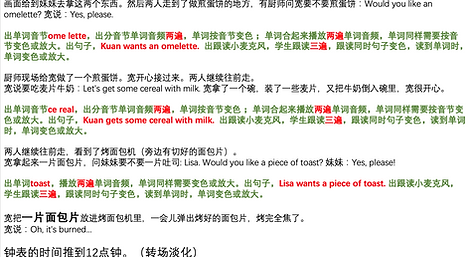
Screenshots of scripts for a story

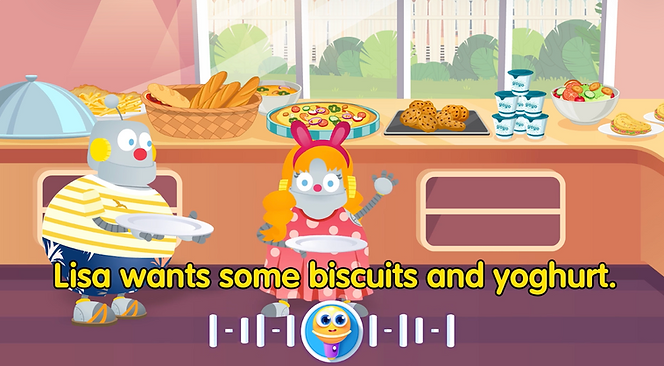
Click the image to watch the story
4. Authoring Tools & Technical Skills
I used TAL's proprietary interactive e-learning development tool — an authoring platform that allows instructional designers to arrange:
-
Triggers (conditional interactions)
-
Layers (progressive content reveal)
-
Interactive elements (drag-and-drop, hotspots, branching scenarios)
-
…
📌 *This tool functioned similarly to Articulate Storyline but was built in-house for TAL's specific K12 content needs.*
5. Team Development – Peer Learning Sessions
I organized periodic training sessions to accelerate team learning and build a shared knowledge base.
How it worked:
-
Each team member was assigned a different chapter from a Cambridge English teaching methodology book
-
They presented their key findings to the rest of the team
-
Sessions enabled the whole team to benefit from multiple chapters without each person reading the entire book
Outcome:
-
Rapid, scalable team learning
-
Shared vocabulary around Cambridge pedagogy
-
Strengthened team culture and knowledge sharing
📌 This approach turned individual reading into collective growth — a model I continue to use in team settings.
6. Mentorship & SME Role
-
Subject Matter Expert (SME) : I passed the China National Teaching Certificate Examination and served as an in-house Cambridge English SME, advising on pedagogy, assessment, and Cambridge alignment.
-
Mentorship: Mentored 3 junior instructional designers, providing feedback on their courseware, lesson structures, and interactive design.
🧰 Tools & Methodologies Used

🧠 Reflection Section
Reflection: From Designer to SME, Mentor & Team Catalyst
This role at TAL was where I grew from a content designer into a subject matter expert, team mentor, and learning culture builder — while still owning end-to-end product development.
What I learned:
-
Dual-modal design is a mindset, not an afterthought: Designing for offline vs. online simultaneously forced me to think deeply about what each format does best — not just converting offline activities to screens.
-
Small online engagement tools matter: Polls, random wheels, and paired role plays seem simple, but they transformed passive screen time into active, unpredictable, game-like moments.
-
Being an SME changes your design perspective: Passing the national teaching certification exam gave me the credibility to challenge textbook scripts and propose better pedagogical approaches — not just execute others' decisions.
-
Team learning scales culture: The peer-led chapter presentations meant the whole team learned faster than any individual could alone. This became one of my most satisfying contributions — not to a course, but to a team.
-
Proprietary tools teach transferable thinking: TAL's in-house authoring tool (triggers, layers, interactivity) taught me that great instructional design is tool-agnostic — the thinking transfers to Storyline, Captivate, or any modern authoring platform.
How this shapes my ID philosophy today:
I now believe that instructional design excellence comes from four overlapping roles:
-
Designer — who creates engaging, effective learning experiences
-
SME — who brings subject matter authority to the table
-
Mentor — who lifts others and multiplies impact
-
Team catalyst — who builds learning cultures, not just learning content
TAL gave me the space to develop all four. Today, I walk into any ID role not just as a course developer, but as a pedagogical leader and team builder.
Contact
I’m always open to meaningful conversations. Let’s connect — whether for opportunities, ideas, or collaborations in learning design.
(+86)175-2683-5198